
Can foreigners still buy property in Australia?
Yes, but not an established home. Not until June 30, 2029. Foreign buyers are limited to new builds, near-new homes, and vacant residential land, all of which need Foreign Investment Review Board (FIRB) approval before you buy.
The Australian government has extended its ban on foreign purchases of established homes by two years and three months. It was due to expire on March 31, 2027; it now runs to June 30, 2029. The extension came in the 2026-27 Budget, and the Australian Taxation Office (ATO) updated its guidance to match on May 12, 2026.
If you’re buying, that removes most of the market from your search. If you’re relocating and had planned to buy on arrival, it changes what you’ll be looking at when you get there. If you already own an established home in Australia and were counting on foreign demand when you come to sell, your buyer pool stays smaller for another two years. And if you’re renting while you wait for the restriction to lift, you’re now waiting considerably longer than you thought.
Below is how the ban came about, who it actually applies to (which is narrower than the headlines suggest), what it means for the homes you can actually buy, and what to do about it now. Because there is a route through this. It’s a narrower market and a more expensive one, but it’s open.
Why did Australia ban foreign buyers of established homes?
The ban took effect on April 1, 2025 as a two-year measure to reduce foreign competition for existing housing, and it sits on top of a decade of state-level surcharges that have only ever risen.
By 2024, housing affordability had stopped being a policy debate in Australia and become the political question. Foreign buyers were an obvious lever. Whether they were ever a large enough share of the market to be a cause of the problem is genuinely contested, but restricting them is straightforward to legislate and popular to announce, which is a combination that tends to survive a change of government.
It’s also the newest layer on something much older. Australia has screened foreign purchases through the Foreign Investment Review Board for decades, and the states have spent 10 years raising charges of their own. Queensland introduced its foreign buyer surcharge at 3% in October 2016, lifted it to 7% in 2018, and lifted it again to 8% in 2024. New South Wales is now at 9%.
The pattern is the useful part. In that decade, no Australian jurisdiction has reduced a foreign buyer charge or let one lapse. This extension is the same measure continuing rather than a new direction, which matters if your plan depends on it ending on schedule.
Who counts as a foreign buyer in Australia?
Anyone who isn’t an Australian citizen or permanent resident, including temporary residents and foreign-owned companies. New Zealand citizens are exempt from the federal ban, but the states apply narrower definitions of their own, so a federal exemption doesn’t give you a state exemption.
This sounds like it should have one answer, and it has several. That’s where people get caught.
The federal ban is the simple part: citizens and permanent residents are out of scope, and so are New Zealand citizens. The state duty surcharges are where it gets specific. In New South Wales you’re treated as foreign unless you’re a citizen or “ordinarily resident”, which means holding permanent residency and having been physically in Australia for at least 200 days in the year before the transaction. A permanent resident who spent that year working overseas fails the test without doing anything wrong.
Victoria went further. For foreign purchaser additional duty, New Zealand citizens have been treated like any other foreign citizen for all settlements from November 26, 2025, unless they meet a six-month residence test. The result is a New Zealander who sits entirely outside the federal ban and still owes 8% additional duty on a Melbourne apartment.
Check your position against the state you’re buying in, not the federal rule. The federal rule is the one that gets quoted; the state rule is the one that gets charged.
What does Australia’s foreign buyer ban mean if you were planning to buy?
You’re limited to new and near-new homes and vacant land, and you’ll pay roughly 10% to 12% above the purchase price in federal fees and state surcharge before ordinary stamp duty is calculated.
Interest in Australia hasn’t dropped, and it isn’t coming from where the coverage suggests. In the 30 days to September 4, 21,887 people searched for Australian property on Properstar from outside Australia. The UK led by some distance at 3,571, followed by Germany at 2,086 and France at 1,770. Mainland China, the origin that dominates reporting on Australian foreign buyers, accounted for 18.
What that demand runs into is a wall with a very specific shape. The ban doesn’t thin your options, it removes a category: every established dwelling in Australia, at any price, in any suburb, until June 30, 2029. Budget doesn’t get you around it, and neither does patience, because the restriction now outlasts most people’s moving plans.
The category that stays open isn’t a technicality. Australia approved 17,687 new dwellings in July, 9% more than in the same month a year earlier. Supply isn’t merely present, it’s growing. New dwellings, near-new dwellings, and vacant residential land all stay open to you, subject to FIRB approval.
What that does to a search is specific. The house in the established suburb with the mature garden is unavailable at any price. The apartment in the tower going up two streets away is available, as is the block in the new estate on the city fringe. You’ll be shopping a narrower market than the local buyers standing next to you, weighted toward apartments over houses, and growth corridors over settled suburbs.
What should foreign buyers do about Australia’s 2029 ban?
Budget the state surcharge first, check which federal fee band your price falls into, and make any contract conditional on FIRB approval.
Start from the assumption that waiting isn’t a plan. Two years was something you could sit out. Four years and three months is long enough that prices, rates, and your own reasons for moving will all have shifted by the time you get there. And the exceptions won’t help, because they’re aimed at investments that significantly increase or support housing supply, not at a person buying one home.
The state surcharge is the number that will actually change what you can afford: 9% of dutiable value in New South Wales, 8% in Victoria, Queensland, and Tasmania, 7% in Western Australia and South Australia, and nothing at all in the Australian Capital Territory or the Northern Territory. On a A$1.2 million apartment that’s A$108,000 in Sydney against nothing in Canberra, before ordinary stamp duty. If the surcharge is what decides your budget, that’s worth knowing before you rule out a city.
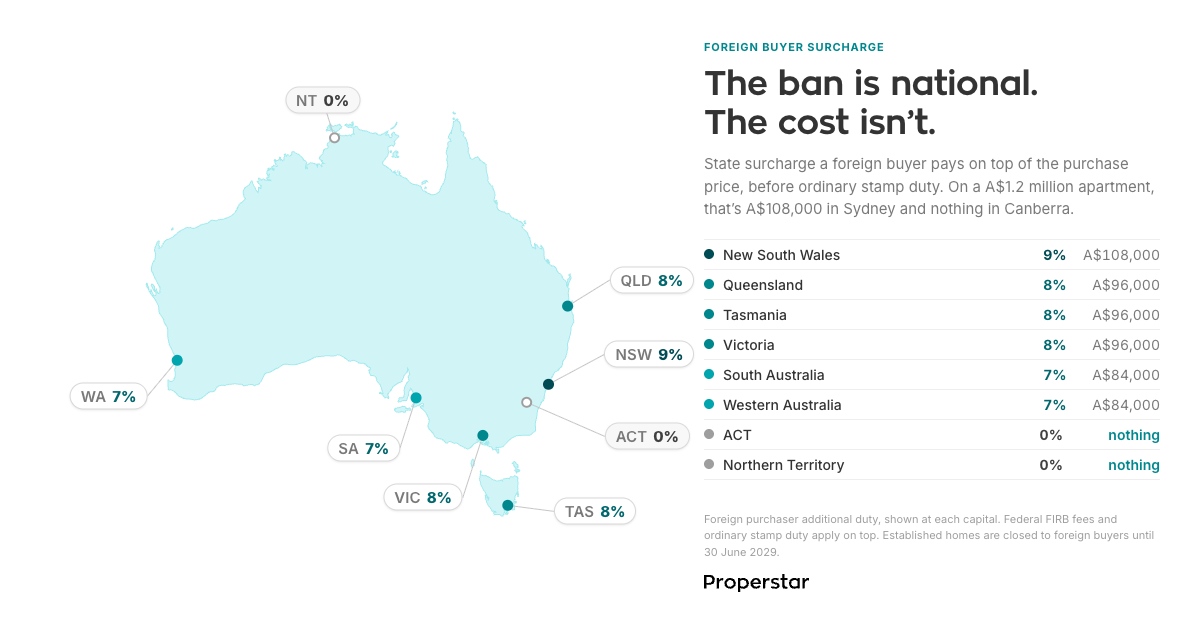
No Australian state has cut one of these surcharges in the decade they have existed. Queensland's has gone from 3% in 2016 to 8% today.
Federal application fees come on top, and they step in bands rather than sliding. A$15,600 up to A$1 million, A$31,300 up to A$2 million. So a purchase at A$1,000,001 costs A$15,700 more in fees than one at A$1 million, and if your budget sits near a band edge, that’s worth more than the discount you were going to negotiate for.
Because your search is now restricted to new stock, the buying process changes with it. Off-plan and near-new purchases turn on completion dates, sunset clauses, and what the contract says happens if the developer runs late, none of which arise when you buy an established home. Raise the FIRB condition and the sunset terms in the same conversation with your conveyancer.
On the approval itself, you don’t need it in hand before going under contract, provided the contract is made conditional on it. Getting that condition written in is the single most useful thing your conveyancer will do for you.
And don’t assume mid-2029 is final. This ban has already been extended once, and no Australian jurisdiction has reduced a foreign buyer charge in a decade. If your plan is to buy an established Australian home, plan for it to stay closed.
If what you wanted was an established home in a settled suburb rather than a new build specifically, that’s available elsewhere. Portugal, Spain, and Greece place no restriction at all on foreign buyers of existing homes, so it’s worth comparing before you commit four years to waiting.